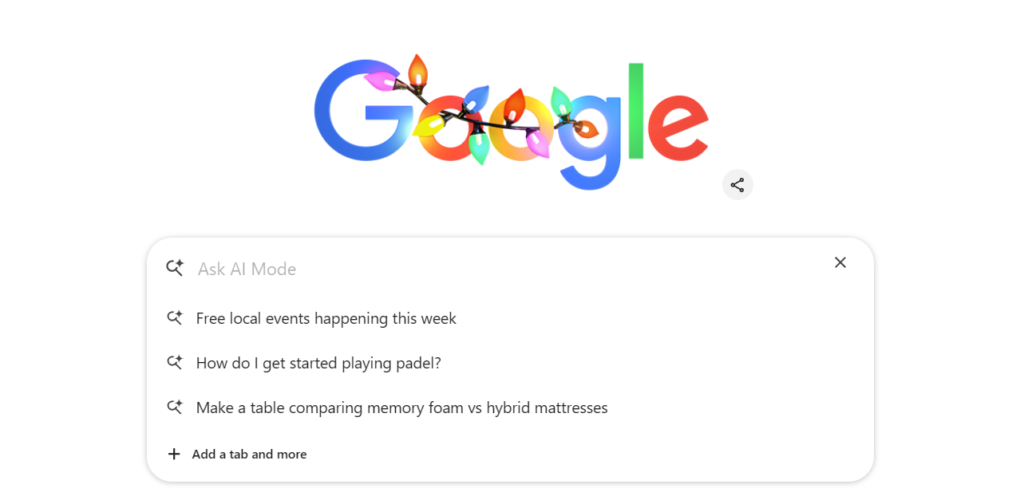
Google’s AI Mode is changing how people find local businesses. Instead of a list of blue links, searchers increasingly see a conversational answer that recommends businesses directly. For local SEO, that means less emphasis on ranking number one and more on whether Google’s AI trusts your business enough to name it.
Editor’s note for review: this post mixes product-announcement details and statistics from the original article. Please verify each [bracketed] item against Google’s current announcements before publishing.
What is changing in Google search
Google has been rolling out a more AI-first, conversational search experience [verify details and model names against Google’s announcement]. The main changes are:
- A more flexible search box: it can take long, natural-language questions and combinations of text, images, video, PDFs or open browser tabs.
- AI Overviews and AI Mode working together: follow-up questions keep the context of the first query.
- Agent-style features: tools that monitor the web for you, check live availability and, for some local services, help with bookings or calls.
- Interactive results: generated widgets and layouts for visual or technical questions.
- Shopping upgrades: a shared cart across Google surfaces, with price tracking and compatibility checks.
- Creator profiles: shareable spaces where trusted creators and publishers can show their latest content.
What AI Mode means for local businesses
AI Mode often shows a conversational answer with business cards pulled from Google Business Profiles, sometimes in place of the familiar map “3-pack”. Industry studies suggest click-through rates can fall sharply when an AI Overview appears and your business is not cited [verify figure, one source says up to 61 percent]. Being named in the answer is becoming as important as ranking first.
Why “entity authority” matters
Google’s AI builds a picture of each business, an “entity”, from many sources: your website, Google Business Profile, directories, reviews and social media. The more consistent, detailed and trustworthy that picture is everywhere, the more likely the AI is to recommend you.
Your Google Business Profile checklist
- Choose an accurate primary category and only a few truly relevant secondary ones.
- Match your services, hours and attributes (parking, payment types and so on) exactly to your website, and update them when they change.
- Stay active: answer reviews and questions, add photos and offers, and treat the profile as a live data feed.
Technical setup and consistency
- Add LocalBusiness and Service schema in JSON-LD with accurate services, offers and location data.
- Use clear images with descriptive file names and alt text that match your services.
- Keep your name, address and phone number identical across your site, Google Business Profile and directories such as Yelp and Tripadvisor.
- Keep key facts (services, locations, licences) in plain HTML, not hidden behind tabs or scripts.
Reviews, content and brand mentions
- Encourage specific reviews. When customers mention “fast service” or “friendly staff”, AI can turn those into helpful summaries.
- Use Review schema and reply quickly to good and bad reviews. This supports trust (E-E-A-T: experience, expertise, authoritativeness and trustworthiness).
- Write answer-first content: answer the main question, then the follow-ups, using headings, FAQs and lists.
- Earn mentions in local news, blogs, forums, social media and YouTube. Even unlinked mentions help.
Conversions matter more than traffic
You may see fewer visits but more serious, ready-to-act visitors. Make action easy:
- Clear calls to action above the fold, such as “Book now”, “Call” and “Get a quote”.
- Short forms and simple paths.
- Fast, mobile-friendly pages.
A 30-minute local AI-readiness check
- Compare your name, address, phone and hours across your site and Google profile.
- Review your primary category and services.
- Check that your site has LocalBusiness schema.
- Ask five happy customers for specific, detailed reviews.
- Add or improve an FAQ on your main service page.
Frequently asked questions
Is the map 3-pack gone?
Not entirely, but AI-generated answers can appear in its place for some searches. Watch what appears for your own keywords.
Do I still need a Google Business Profile?
Yes. It is one of the main data sources for local AI answers.
Will AI Mode reduce my traffic?
Possibly, for some queries. Focus on being cited and on converting the visitors you do get.
Can you check my local setup?
Yes. I offer local SEO audits. Send your website, main location and top three services, or book a free call. See SEO services.
Keep learning
Read next: SEO is dead? and local marketing in New York City.